

Why Does My Dog Lick the Air? Causes and What to Do
Share
Why Does My Dog Lick the Air? Causes and What to Do
You've probably caught your dog suddenly licking the air with a blank stare — it looks bizarre, but it's actually more common than you'd think. As a veterinarian, I see this question frequently. The short answer: air licking has many possible causes, ranging from completely benign to medically significant. Here's how to tell the difference.
Normal Reasons Dogs Lick the Air
Scent Investigation
Dogs experience the world through their nose — they have up to 300 million olfactory receptors compared to our 6 million. When a dog licks the air, they're often pulling scent particles toward the vomeronasal organ (Jacobson's organ) on the roof of the mouth, which processes pheromones and complex scents. This is perfectly normal behavior, especially after another animal has been nearby or food has been prepared.
Anticipation or Excitement
Many dogs lick the air when they're anticipating something they enjoy — a meal, a walk, or affection. If your dog licks the air specifically around feeding time or before a walk, this is almost certainly just excitement.
Learned Behavior
If air licking has ever gotten your dog attention or a treat, they may have learned to repeat it. Dogs are remarkably good at identifying which behaviors produce rewards.
When Air Licking Signals a Health Problem
Nausea and GI Issues
One of the most common medical causes of repetitive air licking is nausea. Dogs experiencing stomach upset, acid reflux, or the early stages of vomiting often lick repeatedly — at the air, at the floor, at surfaces. If your dog suddenly begins licking the air and also shows signs like drooling, restlessness, or reduced appetite, GI distress is likely. A veterinary visit is warranted.
Dental Pain or Mouth Discomfort
A sore tooth, gum irritation, or an object stuck in the mouth can trigger repetitive licking behaviors. Check the gums and teeth for redness, swelling, or foreign objects.
Focal Seizures
Repetitive, involuntary air licking can sometimes be a sign of a focal (partial) seizure — neurological events that affect a limited region of the brain. If the licking is trance-like, occurs in episodes, and your dog seems unaware of their surroundings during the episode, contact your vet promptly.
Anxiety or Compulsive Disorder
Chronic stress or anxiety can manifest as repetitive behaviors in dogs, including air licking. If the behavior occurs in predictably stressful situations (thunderstorms, car rides, separation) or escalates over time, anxiety is worth investigating.
Supporting Your Dog's Calm and Digestive Wellness
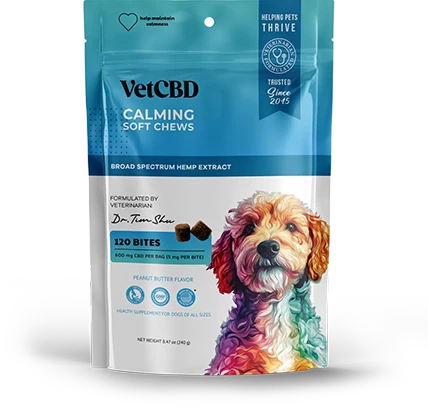
If anxiety appears to be a contributing factor to your dog's air licking, addressing the root cause is the most effective long-term strategy. At VetCBD Hemp, our products are formulated by Dr. Tim Shu, DVM specifically to support balanced behavior and overall wellness in dogs.
Our CBD calming chews for dogs are designed to help dogs maintain a relaxed disposition during stressful situations. For persistent or severe anxiety, we always recommend a free veterinary consultation to rule out underlying causes and build a comprehensive plan.
You can review our full CBD tincture collection and check our third-party lab results for quality assurance.
Frequently Asked Questions
Is it normal for dogs to lick the air?
Occasional air licking is normal — dogs do this to investigate scents or express anticipation. Repetitive, compulsive, or sudden-onset air licking may indicate nausea, dental issues, anxiety, or in rare cases, neurological events.
When should I be worried about my dog licking the air?
Contact your vet if the licking is new, frequent, escalating, accompanied by vomiting or drooling, or appears trance-like. These patterns suggest a medical cause that needs evaluation.
Can anxiety cause dogs to lick the air?
Yes. Chronic or situational anxiety can trigger repetitive behaviors in dogs, including excessive licking of surfaces, objects, or the air. Addressing the anxiety — with behavioral support and veterinary guidance — often resolves the behavior.
